
Mega menu

tetasidjaslkihsdlkjfhsdf gjkhsdfgjklsdhfgjkl shdfgjklhsdfgjkl hsdfjklg hsdfkjlg hsdfjklg hsdfjkl ghsdfjkl ghsdfjklgh


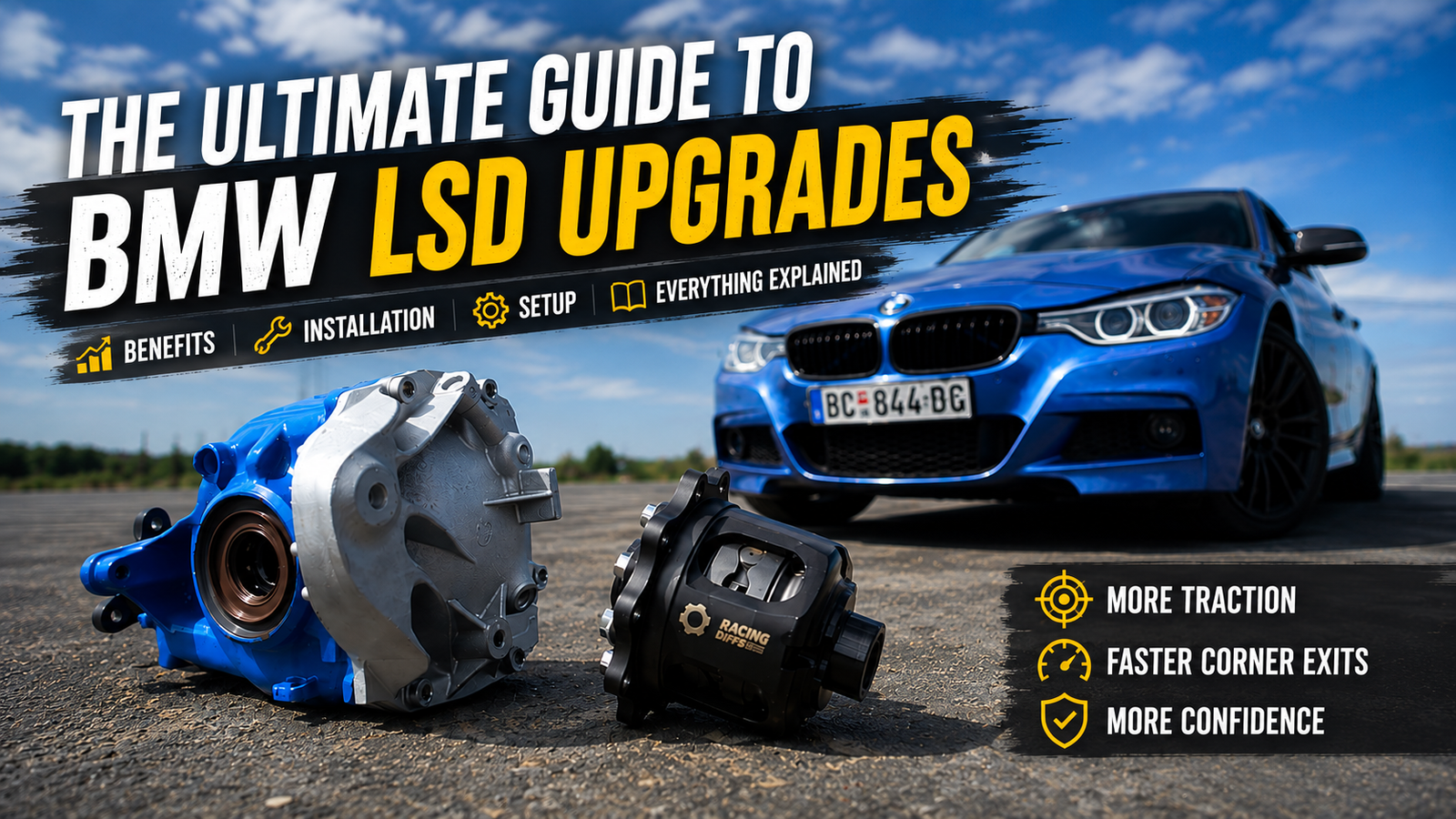
BMW differentials are renowned for durability, efficiency, and performance potential. Whether you're eliminating one-wheel-spin, preparing a drift car, or rebuilding a worn unit, understanding BMW differential sizes and housing generations is essential.
Most enthusiasts recognize BMW diffs by size — 168mm, 188mm, and 210mm (215/220) — but fewer understand housing codes such as MM, K, L, LW, and AL and what they mean for compatibility and performance.
This guide explains:
• Differential sizes and identification
• Housing generations & mechanical changes
• Meaning of BMW diff codes
• Model fitment & timeline
• Performance implications
BMW differentials are categorized by the outer diameter of the crown wheel (ring gear).
Typical use: 4-cylinder and lower-torque engines
Common models: E30, E36, Z3, E46 Compact
Torque capacity: ~250–300 Nm
Most common BMW differential size
Used in: E30, E36, E46, E34, E39, E60, E90, Z3, Z4, X3, X5
Torque capacity: ~450–600 Nm (more with upgrades)
High-performance & V8 applications
Used in: E34 M5, E39 M5, E36 M3 3.2, E60 M5, E63 M6, E32/E38 V8
Torque capacity: 700+ Nm
Early BMW differentials can be identified by counting the side cover bolts:

| Size | Side Cover Bolts |
|---|---|
| 168mm | 4 bolts |
| 188mm | 6 bolts |
| 210mm | 8 bolts |
These housings use threaded side caps and shim packs to set backlash and carrier position.
Later designs eliminated side caps. Size identification is done by measuring the outer diameter of the axle oil seals:
| Size | Oil Seal OD |
|---|---|
| 168mm | 78 mm |
| 188mm | 90 mm |
| 215/220mm | 100 mm |
This method applies to all modern BMW differential generations.
BMW refined differential housings over time to reduce friction, improve efficiency, and simplify assembly.
Used until ~1999
The MM housing represents BMW’s classic differential design.
✔ Threaded side caps with shim adjustment
✔ Carrier preload & backlash set via shims
✔ Extremely robust construction
✔ Higher internal friction compared to later designs
✅ MM housings are the only generation where non-M BMW models were factory-equipped with clutch-type LSD units.
This makes them highly desirable among enthusiasts.
Approx. 2000 – 2005
The K generation marked BMW’s first major modernization step.
✔ Side caps eliminated
✔ Carrier retained by side C-clips
✔ Improved lubrication and structural rigidity
✔ Simplified assembly and service
Recognized by measuring axle seal diameter (78 / 90 / 100 mm).
~2003 – September 2007
Introduced to reduce drivetrain losses and improve fuel efficiency.
✔ Ball bearings replace tapered bearings in key positions
✔ Reduced rotational drag
✔ Lower operating temperatures
✔ Improved efficiency and smoother operation
BMW introduced the L type in early 1-Series production and used it until September 2007.
September 2007 – Present
LW housings evolved from the L generation and remain in use today.
✔ Ring gear welded to the differential carrier
✔ Increased rigidity & strength
✔ Improved torque transfer
✔ Eliminates ring gear bolt failures
⚠️ Requires machining when changing gear ratios.
BMW introduced aluminum housings primarily for weight reduction and thermal efficiency.
✔ Significant weight savings
✔ Improved heat dissipation
✔ Reduced drivetrain mass
✔ Increased efficiency
Most common in F-generation 5 Series and 7 Series, as well as other modern platforms.
Despite the aluminum case, internal gearing remains steel for durability.
BMW engineers redesigned differential housings to:
• improve fuel efficiency
• reduce drivetrain losses
• lower noise & vibration
• improve smoothness
While efficient, low-friction designs may reduce lock effectiveness, which is why performance drivers upgrade to clutch-type LSD solutions.
| Generation | Years | Key Feature |
|---|---|---|
| MM | – 1999 | Side caps & shims, factory LSD option |
| K | 2000–2005 | C-clip carrier retention |
| L | 2003–09/2007 | Low-friction bearings |
| LW | 09/2007–present | Welded ring gear |
| AL | modern | Aluminum housing |
Understanding your BMW differential ensures:
✔ correct LSD upgrade selection
✔ compatibility with rebuild parts
✔ easier identification & servicing
✔ improved durability & performance
At RacingDiffs, we engineer solutions for all BMW differential generations, helping drivers unlock maximum traction on the street, track, or drift course.
BMW’s differential evolution reflects the balance between durability, efficiency, and performance. Knowing whether your unit is MM, K, L, LW, or AL allows you to select the right upgrades and fully exploit your drivetrain’s potential.
If you're unsure which differential your BMW uses, identification methods above will help — or contact RacingDiffs for expert support.
MM housings (pre-1999): count the side cover bolts:
K, L, LW & AL housings (2000+): measure axle oil seal outer diameter (OD):
You can also confirm using the differential tag or vehicle VIN.
Factory clutch-type LSD was available in:
Many later BMW models use open differentials with electronic traction control instead of a mechanical LSD.
Low-friction (L and LW) housings were designed to reduce drivetrain losses by using ball bearings in key locations.
L type: low-friction design with a bolted ring gear.
LW type: low-friction design with a welded ring gear for increased rigidity and strength.
LW started from September 2007 and is still used today.
Yes, LW differentials can be rebuilt and upgraded.
Note: gear ratio changes typically require machining due to the welded ring gear, so professional tools and experience are recommended.
BMW shifted toward electronic traction systems, efficiency improvements, and smoother drivability for mass-market models.
Enthusiasts still prefer mechanical LSDs for track use, drifting, and predictable traction.
No. BMW aluminum housings (AL type) reduce weight and improve heat dissipation while remaining strong enough for factory torque levels.
The internal gears remain steel for durability.
In general, strength increases with ring gear size:
Real-world durability also depends on internal upgrades, setup, and driving style.
A mechanical LSD helps eliminate one-wheel-spin and improves control: